Loop Engineering Crash Course: Build 3 Real AI Agent Loops

Loop Engineering Crash Course: Build 3 Real AI Agent Loops
MP4 | Video: h264, 1920x1080 | Audio: AAC, 44.1 KHz, 2 Ch
Level: All Levels | Genre: eLearning | Language: English | Duration: 15 Lectures ( 51m ) | Size: 668.1 MB
What if you could look inside an AI agent and understand exactly what it is doing?
You use AI tools that can browse the web, write and fix code, research a topic, or handle a task from start to finish. But how do they actually do it?
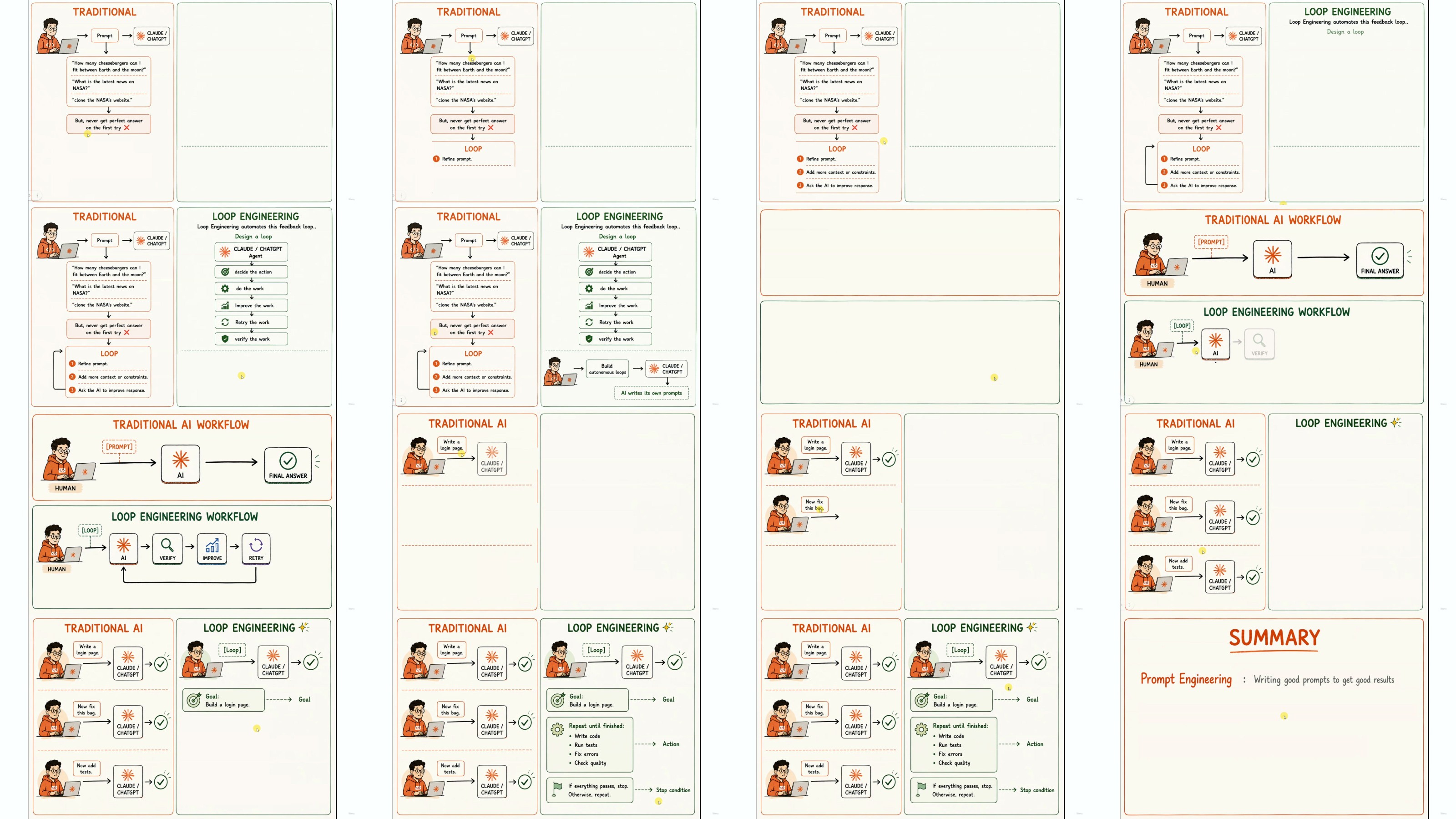
An AI agent usually doesn't solve a complex task in one shot.
It runs a loop:
Think → Act → Observe → Repeat
This loop is what allows an AI system to use tools, evaluate results, correct mistakes, remember context, and continue working toward a goal.
Introduction to Loop Engineering gives you a beginner-friendly introduction to the mechanics behind these AI agents.
In about one hour, you'll learn how agentic loops work, why they fail, how to control them, and how to build a simple working loop yourself.
No formal AI background is required.
What you'll learn
You'll start with the fundamentals: what exactly is an agentic loop?
Using simple, everyday examples, you'll understand how an AI agent differs from a traditional chatbot and how the think-act-observe cycle enables an agent to perform multi-step tasks.
You'll then explore four important loop patterns used in modern agentic systems:
ReAct — reasoning and acting in an iterative cycle
Reflection — reviewing and improving an agent's own work
Tool Use — interacting with external tools, APIs, databases, and other systems
Multi-Agent — coordinating multiple specialized agents to solve a larger task
Rather than just learning definitions, you'll see when each pattern is useful and how the patterns differ.
See agentic loops in real-world scenarios
You'll explore how loops power practical AI systems such as:
Customer support agents that investigate and resolve requests
Coding agents that write, test, debug, and improve code
Research agents that search for information, evaluate results, and continue investigating
You'll also look at the limitations of these systems so you understand not only what AI agents can do, but where they can still go wrong.
Build your first agentic loop
The course then moves from concepts to hands-on learning.
You'll build a simple ReAct-style agent loop step by step, with every important part explained in beginner-friendly language.
You won't need previous experience with AI agents or agent frameworks.
You'll then see a real agentic loop running using Claude Code's /loop command inside Cursor.
You'll be able to follow the loop as it:
Reasons → Calls tools → Observes results → Decides what to do next → Repeats → Stops
You'll learn what information the agent receives at each stage and, most importantly, how the loop knows when to stop.
Learn why AI agent loops fail
Building an agent is only half the problem.
Making it behave reliably is where things get interesting.
You'll learn to recognize three common failure modes:
Infinite loops — the agent keeps working without making meaningful progress
Hallucination loops — incorrect assumptions get repeatedly reinforced
Token blowup — the agent consumes increasingly large amounts of context and tokens